
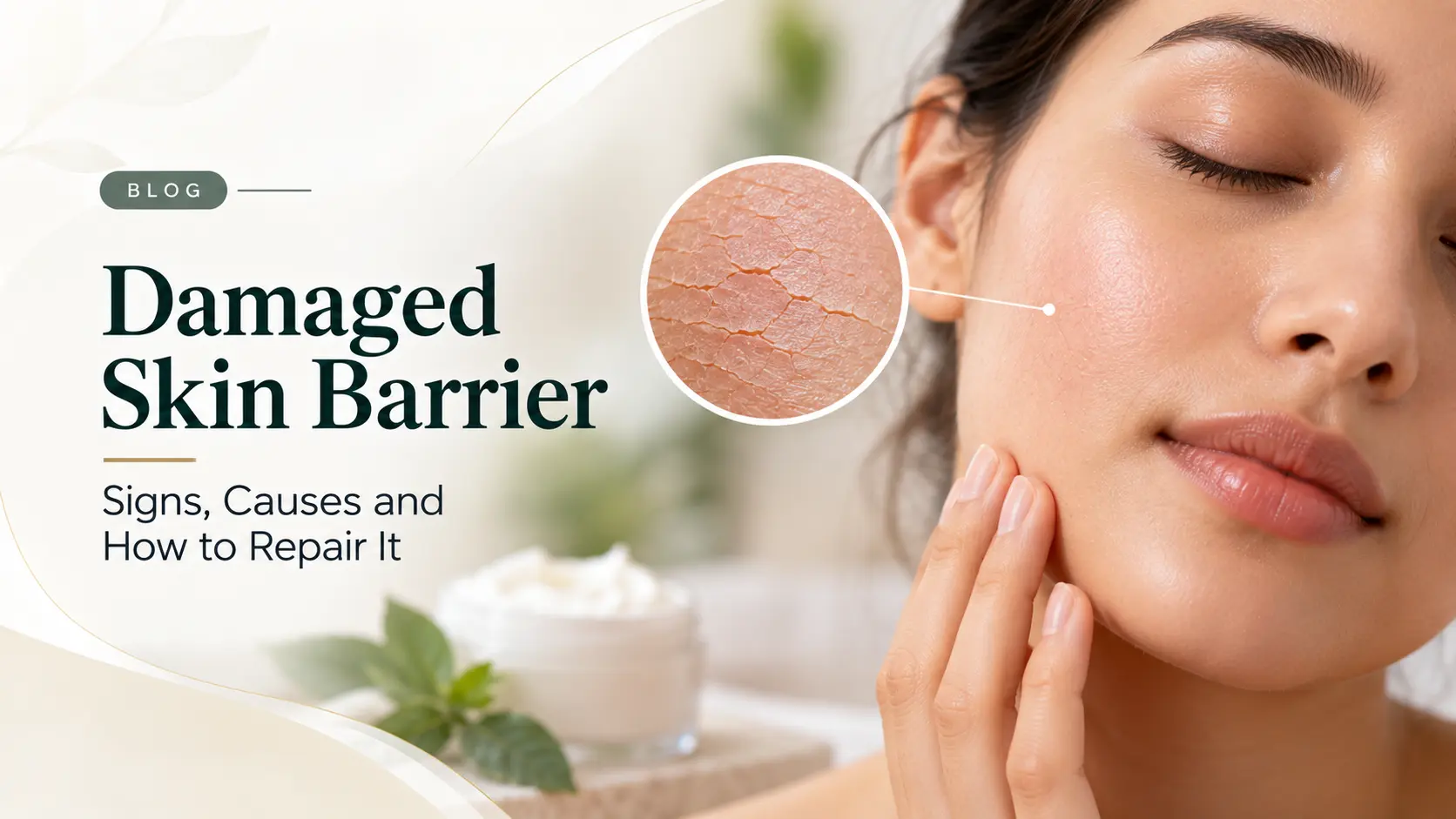
Your skin barrier plays an important role in protecting the skin from external irritants and helping maintain hydration. When the barrier becomes disrupted, the skin may start feeling unusually dry, tight, irritated or sensitive.
Many people respond to these symptoms by adding more active ingredients or trying stronger skincare products. However, if the skin is already irritated, continuing an aggressive routine may make discomfort worse.
Understanding the signs of a damaged skin barrier, what can cause it and how to support recovery can help you make better skincare decisions.
What Is the Skin Barrier?
The skin barrier is the outermost protective layer of your skin. It helps reduce excessive water loss and provides protection against environmental irritants and other external factors.
A healthy skin barrier supports comfortable, hydrated and resilient skin.
When the barrier is disrupted, the skin may become more vulnerable to dryness and irritation.
This does not mean that every episode of dry or sensitive skin represents significant barrier damage. Similar symptoms can occur with eczema, allergies, contact dermatitis, acne treatments and other skin conditions.
What Are the Signs of a Damaged Skin Barrier?
A compromised skin barrier can present differently depending on the individual.
Common signs may include:
1. Persistent Dryness
Your skin may feel unusually dry even after applying moisturiser.
The skin can also develop rough or flaky areas.
2. Tightness
A feeling of tightness, particularly after cleansing, can indicate that your skincare routine may be irritating or drying your skin.
3. Increased Sensitivity
Products that previously felt comfortable may suddenly cause stinging, burning or discomfort.
4. Redness or Irritation
Some people may notice increased redness or irritation after using skincare products or being exposed to environmental triggers.
5. Flaking
The skin may become visibly flaky or rough, particularly around areas that are already dry.
6. Burning or Stinging
If simple products such as moisturisers or cleansers suddenly cause significant stinging, it may be a sign that your skin is more sensitive than usual.
7. Breakouts or Uneven Texture
Some people may notice changes in skin texture or increased breakouts when their routine becomes overly irritating.
However, acne and other skin conditions can also cause these symptoms, so they should not automatically be attributed to a damaged skin barrier.
What Can Damage the Skin Barrier?
Several factors can contribute to skin-barrier disruption.
Over-Exfoliation
Using exfoliating acids, scrubs or other exfoliating products too frequently can irritate the skin.
More exfoliation does not necessarily mean healthier skin.
Excessive Use of Active Ingredients
Combining multiple active ingredients without considering your skin’s tolerance can increase irritation.
For example, using several strong products at the same time may be unnecessarily aggressive for some skin types.
Harsh Cleansers
Some cleansing products can leave the skin feeling very dry or tight, particularly when used too frequently.
Hot Water
Very hot water can increase dryness and irritation.
Using comfortably warm water is generally more suitable for sensitive or dry skin.
Over-Washing
Washing the face excessively may remove protective components from the skin surface and contribute to dryness.
Environmental Exposure
Sun exposure, dry air, pollution and other environmental factors can contribute to skin discomfort and dryness.
Incorrect Skincare for Your Skin Type
A product that works well for one person may not suit another person’s skin.
Skin type, existing skin conditions, climate and the rest of your skincare routine all matter.
Can Skincare Products Damage the Skin Barrier?
Yes, certain products or routines may contribute to irritation when used incorrectly or too frequently.
This does not mean that active ingredients are inherently harmful.
Ingredients such as exfoliating acids and retinoids can have important dermatological uses when appropriately selected and introduced according to individual skin tolerance.
The problem may arise when too many active products are introduced at once or when the skin is not given enough time to adapt.
How Can You Support Skin Barrier Repair?
If your skin feels dry, irritated or unusually sensitive, simplifying your routine may be helpful.
Keep Cleansing Gentle
Choose a cleanser that does not leave your skin feeling excessively tight or uncomfortable.
Avoid repeatedly cleansing the face simply because the skin feels oily at certain times of the day.
Use a Suitable Moisturiser
A moisturiser can help support hydration and improve skin comfort.
Look for a formulation appropriate for your skin type rather than choosing products based only on marketing claims.
Avoid Unnecessary Exfoliation
If your skin is already irritated, temporarily reducing exfoliating products may help minimise further irritation.
A dermatologist can advise when and how to reintroduce active ingredients.
Protect Your Skin From the Sun
Regular sun protection is an important part of maintaining overall skin health.
Choose a sunscreen appropriate for your skin type and use it consistently when exposed to sunlight.
Simplify Your Routine
When your skin suddenly becomes sensitive, using fewer products can make it easier to identify potential triggers.
A simple routine may include:
- Gentle cleanser
- Appropriate moisturiser
- Sunscreen during the day
Additional products can be introduced based on your skin’s needs and tolerance.
How Long Does It Take to Repair a Damaged Skin Barrier?
There is no single recovery time that applies to everyone.
The time required depends on why the skin became irritated, how significant the disruption is, whether an underlying skin condition is present and whether the triggering factor has been removed.
Mild irritation may settle with appropriate skincare, while persistent symptoms may require dermatological evaluation.
Avoid assuming that adding more products will make recovery faster.
Should You Stop All Active Skincare Products?
Not necessarily.
Whether you should temporarily reduce or stop a particular active ingredient depends on the cause of the irritation and your existing skin condition.
For example, someone using prescription treatment for acne or another dermatological condition should not automatically stop prescribed treatment without discussing it with their dermatologist.
If your skin has become significantly irritated after introducing a new product or routine, professional advice can help determine what should be changed.
Damaged Skin Barrier vs Dry Skin: Are They the Same?
No.
Dry skin describes a skin type or condition associated with insufficient moisture, while a disrupted skin barrier describes impaired protective function of the outer skin layer.
The two can occur together, but they are not identical.
Someone with naturally dry skin may have a healthy skin barrier, while someone with oily or combination skin can also develop barrier irritation.
Persistent dryness, redness or burning may also be caused by an underlying skin condition.
When Should You See a Dermatologist?
Consider consulting a dermatologist if:
- Your skin remains irritated despite simplifying your routine
- Moisturisers consistently cause burning or stinging
- Redness persists or repeatedly returns
- You develop significant itching
- Your skin becomes painful or develops cracks
- You develop a rash after using a product
- Your symptoms interfere with daily skincare
- You have an existing skin condition that is becoming worse
- You are unsure whether the problem is dryness, irritation, allergy or another dermatological condition
A dermatologist can evaluate the skin and determine whether there is an underlying condition that needs treatment.
SkinVive’s Skin Conditions service focuses on accurate clinical evaluation and personalised management of skin disorders. The live service page notes that evaluation may include clinical examination, dermoscopy or skin analysis where required, medical history and diagnostic tests when indicated.
Can a Medi Facial Help With Sensitive or Dehydrated Skin?
Some professionally selected medi facial protocols may be appropriate for certain patients with dehydrated or sensitive skin.
However, a facial should not automatically be considered a treatment for every irritated skin barrier.
SkinVive’s Medi Facials service includes a Sensitive Skin Medi Facial using soothing and barrier-repair ingredients and notes that the appropriate protocol is selected after skin evaluation.
If your skin is actively inflamed, painful or experiencing a significant reaction, a dermatologist should assess the condition before any cosmetic or procedural treatment is considered.
What Should You Avoid When Your Skin Is Irritated?
If your skin suddenly becomes sensitive, avoid making your routine more complicated.
Depending on the cause, it may be sensible to temporarily reduce:
- Harsh scrubs
- Excessive exfoliation
- Multiple strong active ingredients
- Very hot water
- Products that consistently cause burning or stinging
- Unnecessary product switching
However, if you are using prescription dermatology treatments, discuss any changes with your dermatologist rather than stopping medication on your own.
Can a Damaged Skin Barrier Cause Acne?
A disrupted skin barrier does not automatically cause acne.
However, irritation and inappropriate skincare can complicate acne management and may make the skin more uncomfortable.
If you have both acne and persistent sensitivity, it is better to have the overall routine assessed rather than treating each symptom separately.
The goal is to manage acne while maintaining a skincare routine that your skin can tolerate.
Skin Barrier Care in Hyderabad
If your skin has become unusually dry, sensitive, irritated or reactive, identifying the underlying cause is more important than simply adding another skincare product.
At SkinVive by Dr. Karishni Chittarvu, dermatology care focuses on accurate assessment and personalised treatment planning. Dr. Karishni Chittarvu’s practice covers skin, hair and nail concerns and emphasises evidence-based, individualised care.
SkinVive serves patients in Kavadiguda, Gandhi Nagar and across Hyderabad.
For patients who may benefit from a dermatologist-guided facial protocol, SkinVive also offers medically supervised Medi Facials tailored according to skin type and concern.
Frequently Asked Questions
What is the fastest way to repair a damaged skin barrier?
There is no single fastest method. Reducing the trigger, keeping the skincare routine gentle, maintaining hydration and allowing the skin time to recover can help. Persistent or significant symptoms should be evaluated by a dermatologist.
How do I know if my skin barrier is damaged?
Common signs include unusual dryness, tightness, stinging, burning, increased sensitivity, redness and flaking. These symptoms can also occur with other skin conditions, so persistent problems should be assessed professionally.
Can moisturiser repair the skin barrier?
A suitable moisturiser can support hydration and help improve skin comfort, but it does not treat every cause of skin irritation. If an underlying dermatological condition is present, additional treatment may be needed.
Should I stop using exfoliating acids if my skin is irritated?
If exfoliating products are contributing to irritation, reducing or temporarily stopping them may be appropriate. The right approach depends on your skin condition and the reason you are using the product.
Can retinol damage the skin barrier?
Retinoids can cause dryness and irritation, particularly when introduced too quickly or used inappropriately. They can also be useful dermatological treatments when appropriately selected and used according to professional guidance.
How long does a damaged skin barrier take to recover?
Recovery time varies. Mild irritation may improve relatively quickly, while persistent irritation or an underlying skin condition may require longer-term management.
Can sensitive skin have a damaged barrier?
Sensitive skin and barrier disruption can occur together, but they are not exactly the same thing. A dermatologist can help determine whether sensitivity is related to barrier irritation, an underlying skin condition or another trigger.
Should I get a facial if my skin barrier is damaged?
Not necessarily. If the skin is significantly irritated or inflamed, it is better to have the condition assessed before undergoing a facial. Some dermatologist-selected protocols may be appropriate for sensitive or dehydrated skin after evaluation.
Final Takeaway
A damaged skin barrier can make the skin feel dry, tight, irritated or unusually sensitive. Skincare habits such as excessive exfoliation, harsh cleansing or introducing too many active ingredients at once may contribute to irritation.
The solution is not always to add more products. In many situations, simplifying the routine, supporting hydration and identifying the underlying trigger are more useful first steps.
If persistent redness, burning, itching, sensitivity or dryness continues, a dermatologist can determine whether you are dealing with barrier irritation or an underlying skin condition.
For patients in Kavadiguda, Gandhi Nagar and Hyderabad, SkinVive by Dr. Karishni Chittarvu provides personalised dermatology care based on individual skin needs.
Explore SkinVive’s skin-condition care or learn about dermatologist-guided Medi Facials.
For clinic directions, find SkinVive on Google Maps.
Leave a Reply